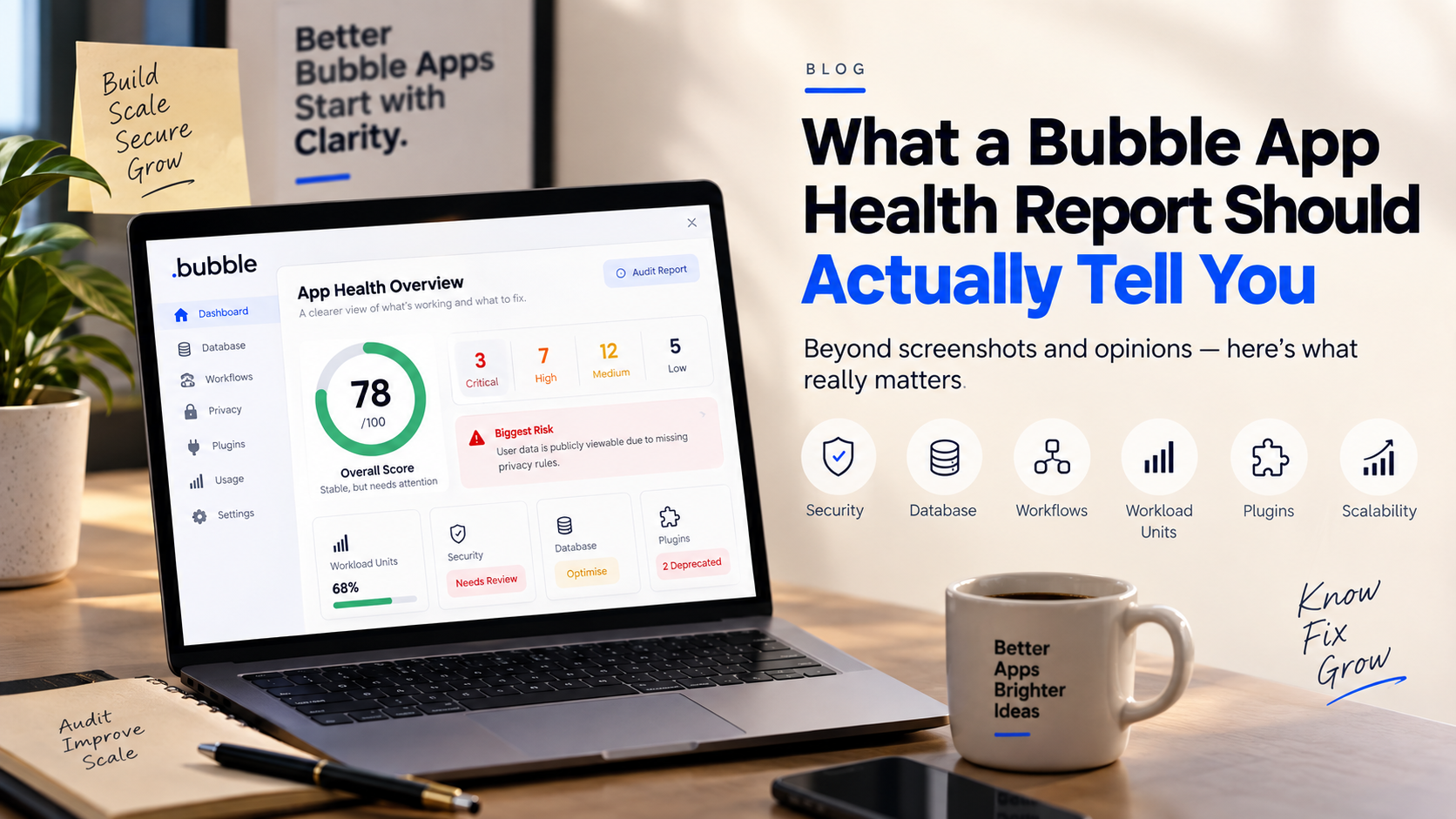

Two quotes for the same platform, same week. One says $29 a month. The other says $95,000. Neither of them is lying to you. They just counted different things.
Before either number matters, though: CB Insights looked at hundreds of dead startups. Roughly 42% died because nobody wanted the thing they'd built. Their 2024 study of 431 failures landed at 43%. Startup Genome found something similar from a different angle: 74% of fast-growing failures scaled too early. Which means your real financial risk was never the build cost. It's the odds that you built the wrong thing.
Now, the bills.
What Bubble actually costs
Bubble runs $29/month for 175,000 workload units, up to $349 for 500,000. A workload unit is just how Bubble measures server effort — every database lookup, every workflow step. Go past your limit and it's $0.30 per extra thousand, and there's no ceiling on that.
Past about 1,000 daily users, most teams are paying $800–$2,500 a month. Real production apps sit around $1,500–$3,500. The part that surprises people: a sloppy build eats those units 5–10 times faster than a clean one. So the bill tracks whoever built it more than it tracks your traffic.
What custom code actually costs
Custom code starts at $50,000–$120,000 for a proper B2B SaaS, over three to six months. Then the meter runs. Every year, keeping it alive costs 15–25% of what you paid to build it — 30–40% if the code's a mess. Stripe's research puts developers at 17.3 hours a week just fixing old code. By year three, upkeep has usually cost more than the original build.
And on speed, McKinsey and Forrester clocked it at 3.2 weeks versus 14.8. That's 74% faster.
The part we'd rather you hear from us
Now the part we'd rather you hear from us than from someone's procurement officer.
Bubble has SOC 2 Type II. That covers Bubble's platform — not your app. You still need your own audit, and 42% of companies now want one before they'll sign. Health data is genuinely hard, because you're sharing infrastructure. You can't export your code, so leaving means rebuilding from scratch. And Google has trouble reading Bubble pages, which costs you in search.
Five signals it's time to leave
There's a point where you should leave. Five signals:
- Past 1,000 monthly users
- Bill over $1,000/month
- Three features the platform won't let you build
- About to hire a senior engineer
- Raising money inside a year
One of those, fine. Three, you're at a wall.
The wins are real too
Dividend Finance built on Bubble, raised $365 million, moved over $1 billion in loans, and got acquired by Fifth Third Bank. Comet reached $800,000 in revenue on Bubble, raised $13 million, and only then moved to code. Both of them bought certainty first and code second. That's the actual lesson.
So: Bubble is cheaper while you're still figuring out what to build. Custom code is cheaper once you know. Almost every platform passes through both. The expensive mistake isn't picking one — it's not noticing when you've crossed over.
GoldenAxe Technology Solutions builds on Bubble. We've also told clients to leave it. Bring your numbers.