87% of enterprise developers now use no-code or low-code.
A founder I know quoted ₹18 lakhs to build a customer portal. Six months timeline. His competitor shipped the same thing in 19 days for ₹40,000. The difference wasn't the budget. It was that 87% of developers have already switched lanes and most B2B owners haven't noticed.
What no-code and low-code actually are?
Traditional software development is like building a house brick by brick, where every wall, every wire and every pipe is laid by hand by specialists who studied for years to do it right. It is slow and expensive, and one wrong move means you are tearing down a wall. That is how most B2B companies are still getting their software built today, quote after quote, scope after scope, six months later with fingers crossed and budgets quietly bleeding.
Now picture the same job someone gave you Lego pieces, but enterprise-grade. Walls, plumbing, electrical all pre-built, tested, and ready to snap together. You drag, drop and connect. The thing works in days, not months. That's no-code.
Low-code is the same idea, but you can still pick up a hammer when the Lego pieces don't quite fit. It's for people who can write a little code but don't want to write everything from scratch.
That's the whole game. Visual building blocks instead of typed instructions. The "magic" everyone keeps talking about is really just the death of unnecessary friction.
Why 87% is the number that should keep you up at night
When 87% of professional, salaried, computer-science-trained enterprise developers use these tools, it tells you something important: this is not citizen developers replacing coders. This is the way many companies are now building software faster, cheaper, and with far fewer technical barriers.
The professionals adopted it first. Quietly. While the rest of the world was still arguing about whether it was "real" development.
Here's what they figured out:
Organizations adopting low-code platforms report development cost reductions of 53% and project completion times that are 56% faster than traditional methods. Forrester reports that companies using low-code platforms reduced development time by 70% and IT costs by 40%.
The dashboard your dev team quoted at 6 months and ₹40 lakhs? Someone, somewhere, just built a working version of it in 3 weeks for a fraction of that. They're already using it. You're still in the kickoff meeting.
The market itself is screaming the answer
Gartner projects the low-code development technologies market will hit $44.5 billion by 2026, with 75 percent of new enterprise applications built on low-code and 80 percent of low-code users coming from outside IT. The low-code market has reached $28.75 billion in 2025 with expectations to reach $264.40 billion by 2032 at a 32.2% CAGR.
Capital follows truth. VC funding in no-code/low-code startups reached $4.8 billion in 2025, despite a broader venture capital slowdown. Enterprise low-code spending grew 31% YoY in 2025, outpacing overall IT spending growth of 8%.
When enterprise spend is growing four times faster than the overall IT budget in a tight economy — that's not hype. That's CFOs, after months of internal review, signing off because the numbers worked.
The ROI is good.
This is where the story stops being abstract for any B2B founder reading this.
Ricoh achieved 253% ROI with full payback in 7 months using OutSystems. Microsoft Power Apps delivered 206% ROI in a Forrester TEI study. OutSystems delivered up to 66% efficiency gains, a three-year 506% ROI, and paid back its investment in less than six months. Organizations save $187,000 per year on average after implementing low-code.
Organizations using no-code platforms save an average of $1.7 million annually, according to Forrester Research.
Building an app the traditional way typically costs $20,000 to $50,000, while a low-code platform subscription is about $300 per year. For larger-scale projects, low-code platforms average $3,000 per month, compared to traditional development costs that can soar to $70,000–$100,000 or more.
Sit with those numbers for a second. A B2B owner who hires a custom dev shop pays a six-figure number and waits half a year. Their competitor pays a subscription and ships in a month. By the time the first one launches, the second one is already iterating on customer feedback from their second product.
This is the kind of asymmetry that ends companies. Not dramatically. Just slowly, quarter by quarter, until one day the founder looks up and asks how the smaller player got so big so fast.
Eighty-seven percent of enterprise developers have already switched lanes, and the B2B owners pretending this is a passing fad will spend the next three years wondering how their smaller competitors out-shipped them.
You do not need to become a "no-code company." You just have to stop building software the way 2015 told you to. The cost of trying has never been lower, and the cost of waiting has never been higher.
Where Goldenaxe comes in
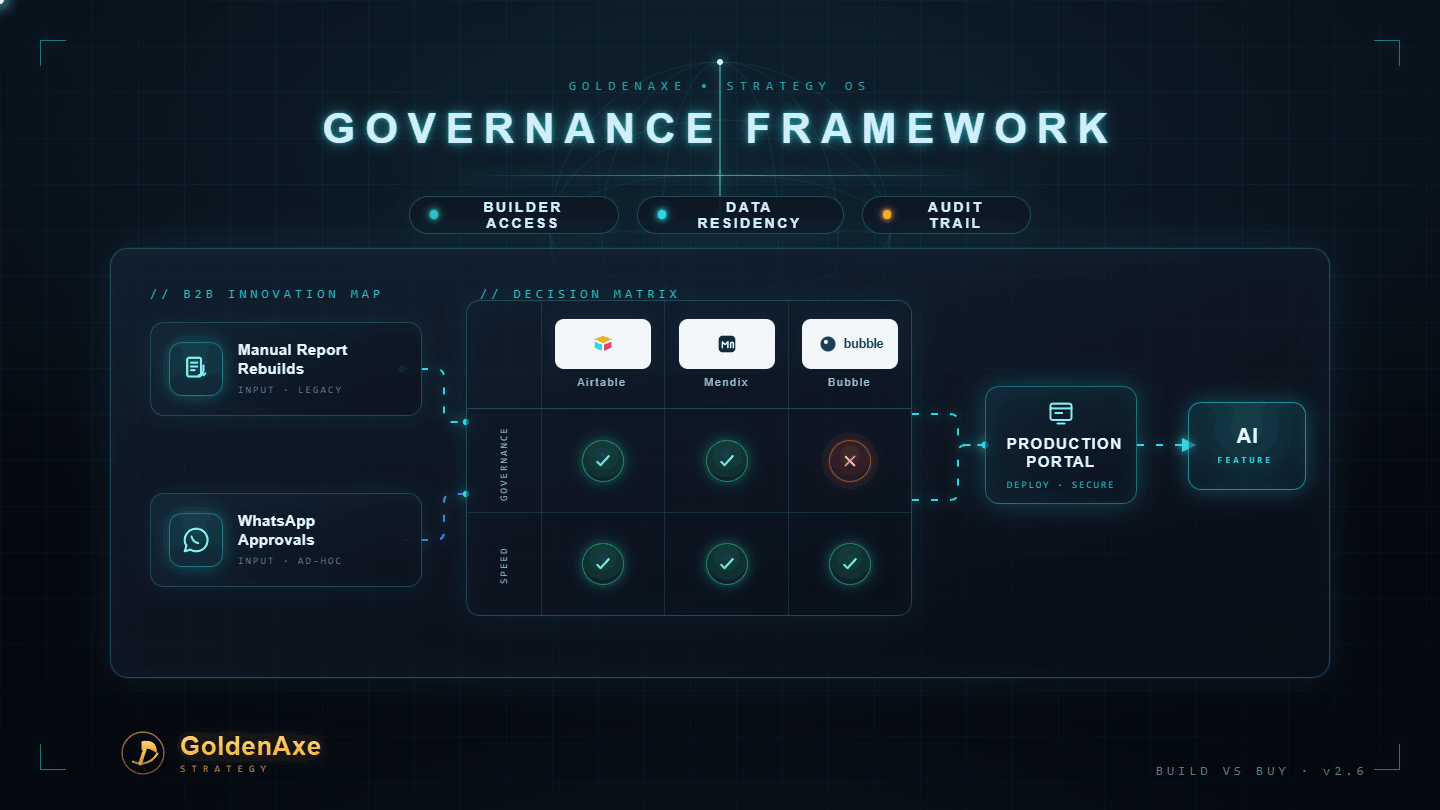
At Goldenaxe.io, we turn six-month quotes into three-week launches building no-code and low-code B2B tools, customer portals, automation workflows and SaaS MVPs the way modern enterprises actually build now.
Visit Goldenaxe.io and book a free 30-minute build review. Bring us one painful workflow — we will show you honestly how fast it can ship.
87% already know. Your turn.