
Internal dashboards. CRM extensions. Customer onboarding portals. Approval workflows. Sales pipelines. Inventory trackers. AI-powered chatbots. Customer support ticket systems. Quotation generators. Order management systems. Vendor portals. Compliance reporting. HR onboarding flows. Field service apps. Lead-scoring tools wired into your existing data.
Financial services lead adoption at 82%, driven by regulatory compliance automation and customer-facing app needs. Healthcare runs patient intake systems on it. Manufacturing runs production-floor apps. Logistics runs route management. Puma Energy improved logistics and market responsiveness with Kissflow's low-code platform. Worcestershire County Council achieved a 442% ROI by using OutSystems.
The boring, expensive, slow stuff that used to be quoted in person-years and signed off with a wince — that's where the gains are quietly being made.
The thing nobody selling you a platform will tell you honestly
There are real risks, and a smart B2B owner needs to walk in with eyes open.
Vendor lock-in is the hidden tax on no-code platforms.
Statement: Most no-code and low-code tools don't give founders access to their source code.
Problem: When you want to migrate, you're rebuilding from scratch. And when your vendor doubles prices (they will), you're trapped, paying whatever they ask because leaving costs more than staying.
Smart B2B founders ask three questions before signing:
- Can I export my data in a usable format?
- Does the platform use open standards?
- What's my exit plan if this vendor disappears or pivots?
Lock-in is a business risk. Audit it before you scale on it.
Shadow IT explodes when everyone can build.
GenAI is turning every employee into a potential developer. That's powerful, but without governance, you end up with 40 unsanctioned apps holding sensitive customer data, none documented, all critical to someone's workflow.
Rogue citizen developers aren't the vibe. But trained ones, building on an enterprise low-code platform with IT guardrails and backup checks, are a force multiplier.
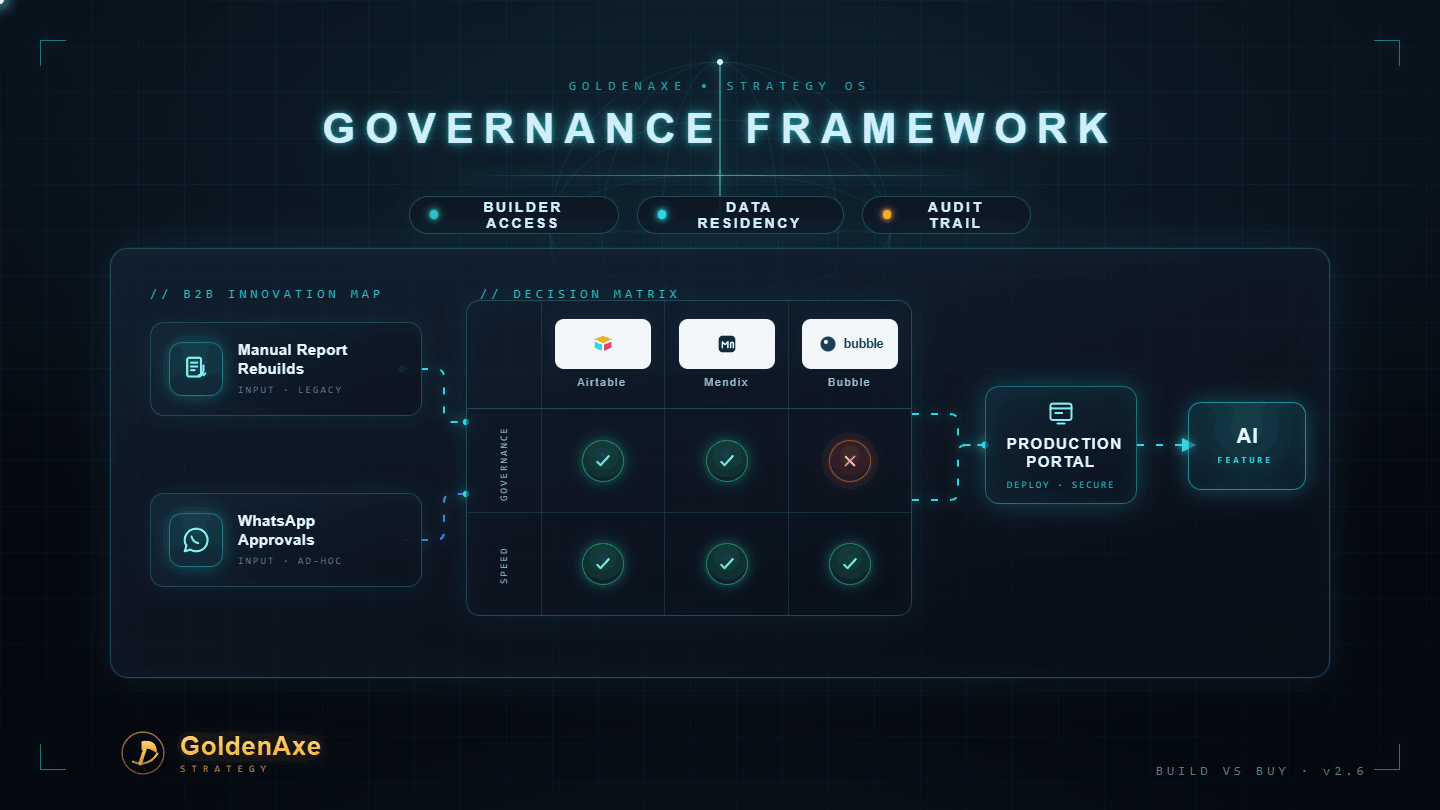
The difference between asset and liability? Governance. Decide who can build what, on which platforms, with what data, before your team decides for you.
Security isn't automatic, even on enterprise platforms.
Low-code platforms have matured. Most major ones now carry SOC 2 Type II and ISO 27001 certifications. But the apps built on top of them are only as secure as the person building them.
Compromised libraries, leaky APIs, sensitive data exposed through integrations the builder didn't fully understand — these aren't platform failures. They're governance failures. When non-IT teams ship apps without security review, you lose visibility into how data flows, who has access, and where your exposure actually lives.
The platform handles its layer. You're still responsible for yours.
Customization has a ceiling. Know where it is.
Low-code is great for general use cases. It struggles where your business is genuinely differentiated.
If you have a truly novel core, something proprietary that's your actual moat, you probably can't and shouldn't build that piece on a platform. The rule of thumb: build the 80% that's standard on low-code. Code the 20% that's your edge.
Trying to force your differentiator through a no-code abstraction layer means you'll fight the platform forever, and your competitors with custom code will ship circles around you.
Not everything works. Be honest about fit.
The data is sobering: 31% of enterprises using low-code haven't used it for their most valuable applications. 32% don't believe these platforms can build what their business actually needs.
The honest read: low-code isn't magic. It fits some problems beautifully with internal tools, workflow automation, dashboards, customer portals. It fits others poorly: anything performance-critical, anything deeply custom, anything where your competitive edge lives.
Pick your battles. Use low-code where it wins. Don't force it where it doesn't.
Here's what GoldenAxe will tell you that platform vendors won't.
Every no-code and low-code vendor on the planet will tell you their platform fits your business. Of course they will — that's their pipeline.
We won't. We'll look at what you're actually trying to build and tell you straight:
You should use low-code when → You're building internal dashboards, CRM extensions, approval workflows, customer portals, vendor management, compliance reporting, or any of the boring-but-expensive operational tooling that's been quoted in person-years for too long. This is where you win — faster shipping, lower cost, real ROI.
You should not use low-code when → Your application is your moat. When performance, deep customization, or proprietary logic is the actual product. When the cost of vendor lock-in outweighs the speed gain. When the app handles data sensitive enough that governance gaps become existential. When you're building the 20% that's your edge — that needs code.
We don't get paid more if you pick the expensive path. We don't get paid more if you pick the platform path. We get paid to tell you which one actually fits — and then build it properly, with governance, exit strategy, and security baked in from day one.
If you're staring at a build-or-buy decision and want an honest second opinion before you commit a budget — let's talk.
Connect with GoldenAxe, we'll tell you where low-code wins for you, where it loses, and what to build either way.